How to Plan a Corporate Chair Massage Event: A Step-by-Step Guide for HR & Office Managers

Updated: Sep 10

You said yes to chair massage for your team. Good call. Now comes the part nobody warns you about: a relaxing perk can turn into a stressful afternoon if the planning is off. Picture the version that goes wrong. Twelve people crowd a chair tucked into a noisy hallway, a line forms by the printer, and half the team never gets a turn before the therapist has to pack up.
That version is entirely avoidable, and it comes down to a handful of decisions you make before the day arrives. This guide walks through each one, with the actual numbers you need to get them right. If you want the background on what on-site chair massage is and what a session feels like first, our companion post on how on-site chair massage works in an office covers that. This post assumes you're past that point and ready to run the event.
Want to skip the math? Tell us your headcount and event window, and we'll map out therapists, session lengths, and a schedule for you. Get your free corporate quote →
The Four Decisions That Make or Break a Corporate Chair Massage Event
Every smooth corporate chair massage event we've delivered across Sacramento and Placer County comes back to four planning choices: when you book, how many therapists you bring, how long each session runs, and how you schedule people. Get those four right and the rest is logistics you can handle in an email. Get them wrong and no amount of day-of energy will save it.
Let's take them in order.
Decision 1: Book earlier than you think you need to
Therapist availability is the constraint, not your calendar. For most corporate events, two to four weeks of lead time is comfortable. That gives you room to confirm a date, lock in the right number of therapists, and send your team enough notice to actually show up.
Two windows tighten that timeline. The first is employee appreciation season in early March, when half the HR teams in the region want the same week. The second is November and December, when holiday gatherings stack up. If your event lands near either, give yourself three to four weeks minimum. Last-minute bookings sometimes work when a therapist has an open block, but planning around that is a gamble, not a strategy.
A practical move: pick your date, then work backward. Count back two weeks for booking and one day for the reminder email, and you have your whole timeline before you've sent a single message.
Decision 2: How many therapists you actually need
This is the number people guess at and get wrong. The math is simple once you see it.
One therapist comfortably serves three to six people per hour, depending on session length. Shorter sessions mean more people per hour; longer sessions mean fewer. So your therapist count is a function of three things: how many employees you want to reach, how long your event runs, and how long each session is.
Here's the quick reference:
1 therapist, 2-hour event, 15-minute sessions: roughly 8 people served
1 therapist, 4-hour event, 15-minute sessions: roughly 16 people served
2 therapists, 3-hour event, 15-minute sessions: roughly 24 people served
If you have a team of 40 and a three-hour window, two therapists won't reach everyone, and that's worth knowing in advance. You then choose: add a third therapist, extend the window, shorten sessions to 10 minutes, or run it as a come-when-you-can perk rather than a guaranteed turn for all. Any of those is fine. Discovering the gap on the day is not.
Decision 3: Session length is a trade, not a default
Most teams reach for 15 minutes, and that's a reasonable starting point. But the length you pick is really a trade between depth and reach, so make it on purpose.
A 10-minute session moves the most people through and works well for high-traffic settings like a wellness fair or a conference activation. A 15-minute session gives the therapist time to work the upper back, shoulders, and neck where desk tension lives, while still keeping the line moving. A 20-minute session is the most common single-session length for a reason: it lines up almost exactly with a standard break, and it's long enough that people leave the chair feeling genuinely reset.
Research on workplace massage backs this up: a 15-minute seated chair massage given on site produced significant drops in both systolic and diastolic blood pressure among 52 employees, so no session length on this menu is too short to matter.
Decision 4: Sign-ups beat walk-ups for most teams
You have two ways to run the flow, and they are not equal.
With a sign-up sheet, every employee picks a slot in advance. They know exactly when to step away, there's no waiting, and you can see your coverage before the day. The risk is the occasional missed slot when someone gets stuck on a call.
With walk-up, people come whenever they like and wait their turn. It's flexible and it suits casual settings, but it produces the printer-line problem and it leaves quieter employees skipping the perk entirely rather than joining a queue.
For a planned corporate event with a known headcount, we recommend sign-ups nearly every time. The five minutes it takes to share a scheduling link buys you a calm, predictable afternoon. As Amy G. from Schools Insurance & Risk Group put it after one of their staff events, the Nurture team is "super professional, always on time, and really easy to work with. They make it simple to set up a relaxing treat for our staff." That ease is mostly upstream planning, and scheduling is the biggest lever you have over it.
The space you'll need
Chair massage asks very little of your floor plan, but the few requirements are non-negotiable for a good experience. Per chair, plan for:
About a 6-by-6-foot footprint, so the therapist has room to work on every side
A quiet, semi-private spot, away from the front desk, the kitchen, and high-traffic doorways
A power outlet within reach
A small table for supplies and a nearby trash can
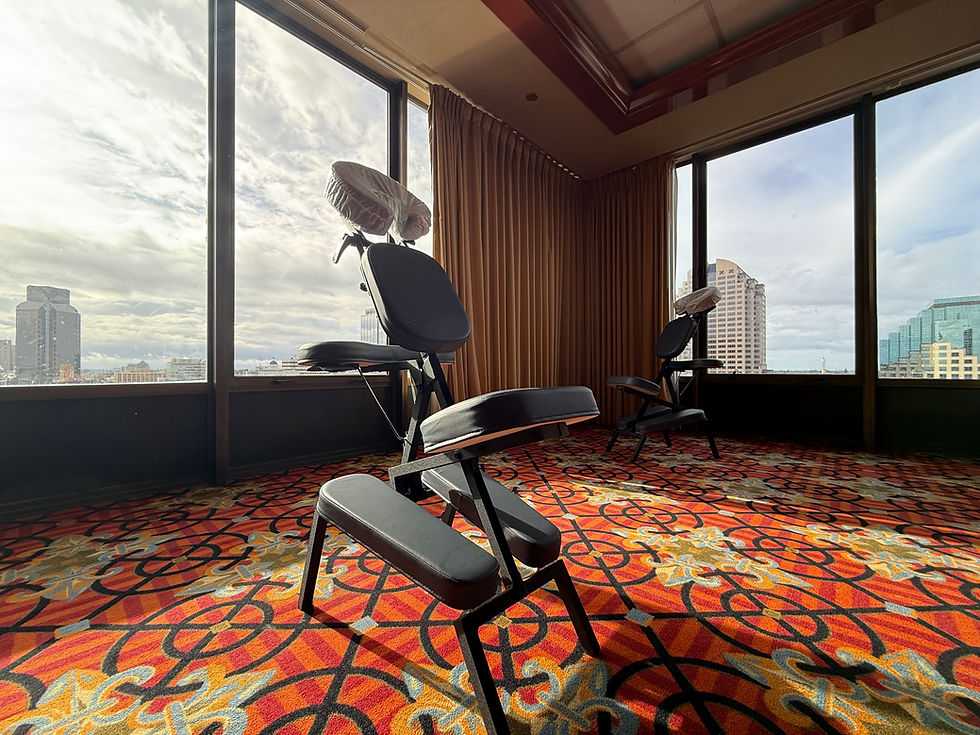
An empty conference room, a quiet corner of an open office, or a reserved breakout space all work. The thing to avoid is the busy thoroughfare. Massage is about letting the nervous system downshift, and that's hard to do six feet from the coffee machine.
Your day-of run-of-show
By the time the event arrives, the planning has done its job. A simple timeline keeps it that way.
Reserve the room for 30 minutes before and after your published start and end times. Your therapists arrive 15 to 30 minutes early to set up the chairs and supplies, so the first appointment starts on time rather than during setup. The single most effective thing you can do for turnout is send a reminder email the day before with the location and the sign-up link. Participation rises sharply when people are reminded the morning isn't a normal one.
Then you mostly get out of the way. A well-planned chair massage event runs itself, and the feedback tends to sound like what Mallory, a teacher at Roseville City School District, said after a session: "A thoughtful and refreshing break in the workday. I walked away relaxed, recharged, and ready to take on the day." That feeling is the entire point, and it's also good business. The Society for Human Resource Management has found that a strong majority of HR professionals link employee recognition to better retention, and a chair massage event is recognition your team can feel in their shoulders.
Let us handle the logistics
Most of the decisions above get easier with a partner who has run hundreds of these events. Tell us your headcount and your window, and we'll tell you exactly how many therapists and what session length will reach your whole team. We serve corporate teams and mid-size businesses across Sacramento and Placer County, and we make the setup genuinely simple.
When you're ready, request a corporate quote or use our pricing calculator to start planning your event. If budget is your next question, our corporate chair massage pricing guide breaks down exactly what to expect.